weight 8,39gr. ; silver Ø 20mm.
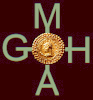
obv. Facing bare headed bust of Atargatis (Ateh) with flowing short hair and
collar, the Aramaic text; H D D R A T H (hd′d w′th = Hadad and Ateh,) to left
rev. Quadriga of goats right, carrying driver and draped male figure wearing
crenelated crown (the Persian King ?), Aramaic ′byty (Abyaty) above
Little is known about the history of the north Syrian city called Bambyke, or Manbog by its Semitic inhabitants. However we know that it was the location of the important sanctuary of Atargatis. Its site in now Membij, to the northeast of Aleppo. It lay to the west of the Euphrates and was within the Persian satrapy of Ebarnahara. Bambyke retained its religious importance after the Macedonian occupation of the region that was sequel to Alexanders′ victory at the Battle of Issos in 333 BC. Seleukos I built a new temple to Atargatis and renamed the town Hierapolis (″Sacred City″). However it is certain that is was already an important centre for the cult of the Syrian Goddess, Atargatis, and her consort, Hadad under Persian rule. Hadad was the storm and rain god in the Canaanite and ancient Mesopotamian religions.
Alexander′s conquest of the region had varied effects on local coinage. There was a short transitional phase during which old coinages were phased out and new Macedonian coinage was introduced, circa 333 to 328 BC. The Local coinages of Philistia, Samaria and Judea all came to an end. The High Priests of Bambyke minted all their ephemeral coinage in the aftermath of the change to Macedonian suzerainty. The coin are silver local shekel (staters or didrachms) of Attic weight, which indicates that they were minted later than the Battle of Issos (333 BC). There is general consensus that the High Priest ′Abd Hadad′ minted the first coins minted circa 332 BC. There is less unanimity concerning the time span of the coinage. The more likely view is that all the coinage had been minted by 323 BC.
Atargatis was the chief goddess of northern Syria in Classical antiquity. The name Atargatis derives from the Aramaic form ′Atar′ atheh. The name ′Atar′ atheh is widely held to derive from a compound of the Aramaic form ′Attar. The second half may be a Palmyrene divine name ′Athe. It has also been proposed that the element -gatis may relate to the Greek gados ″fish″. So Atar-Gatis may simply mean ″the fish-goddess Atar″. Ctesias also used the name Derketo for her, and the Romans called her Dea Syria, or in one word Deasura. Primarily she was a goddess of fertility, but, as the baalat (″mistress″) of her city and people she was also responsible for their protection and well-being. Her chief sanctuary was at Bambyke (later renamed in Hierapolis). Her consort is usually Hadad. As Atar′ atheh, doves and fish were considered sacred to her: doves as an emblem of the Love-Goddess, and fish as symbolic of the fertility and life of the waters.
This coin has a countermark ″rosette″ in the right field of the obverse. On the reverse, on the back of the most right standing goat it has a small test cut, but also a counter ″Aramaic letter Nun (N)″. Almost all the known examples of this cointype have testmarks or bankersmarks/countermarks. This very rare coin type was probably not a common sight in the payment system, so people were suspicious of the quality of the silver. By applying test cuts they wanted to convince themselves of the good quality of the silver and this confirmed with one or more countermarks.
provenance; Ex Garth R.Drewry Collection.
ex Sotheby′s Zürich 27-28 Oktober 1993, 816; ex NFA 25, 1990, 185.
Mildenberg, ″A note on the coinage of Hierapolis Bambyce,
″Travaux Le Rider, 5 (this coin) ; Seyrig, ″Le monnayage de Hieropolis
de Syrie à l′epoque d′Alexandre,″ RN 1971, pl. 1, 4 ;
Price, ″More from the Memphis and the Syria 1989 hoard,
″ Essays Carson-Jenkins, pg. 34, 16-17 ; BMC Syria - ; SNG Copenhagen - ;
SNG München- (cf. 453) ; HGC.9, no.1344 (this coin) ; Mitchiner ATAEC,
page 476, no.1300 ; Brindley (2003), 586 RR
An interesting and fascinating issue of great historical interest. Very rare.
Probably one of the best preserved pieces of the type.
vf/xf


 |
|

